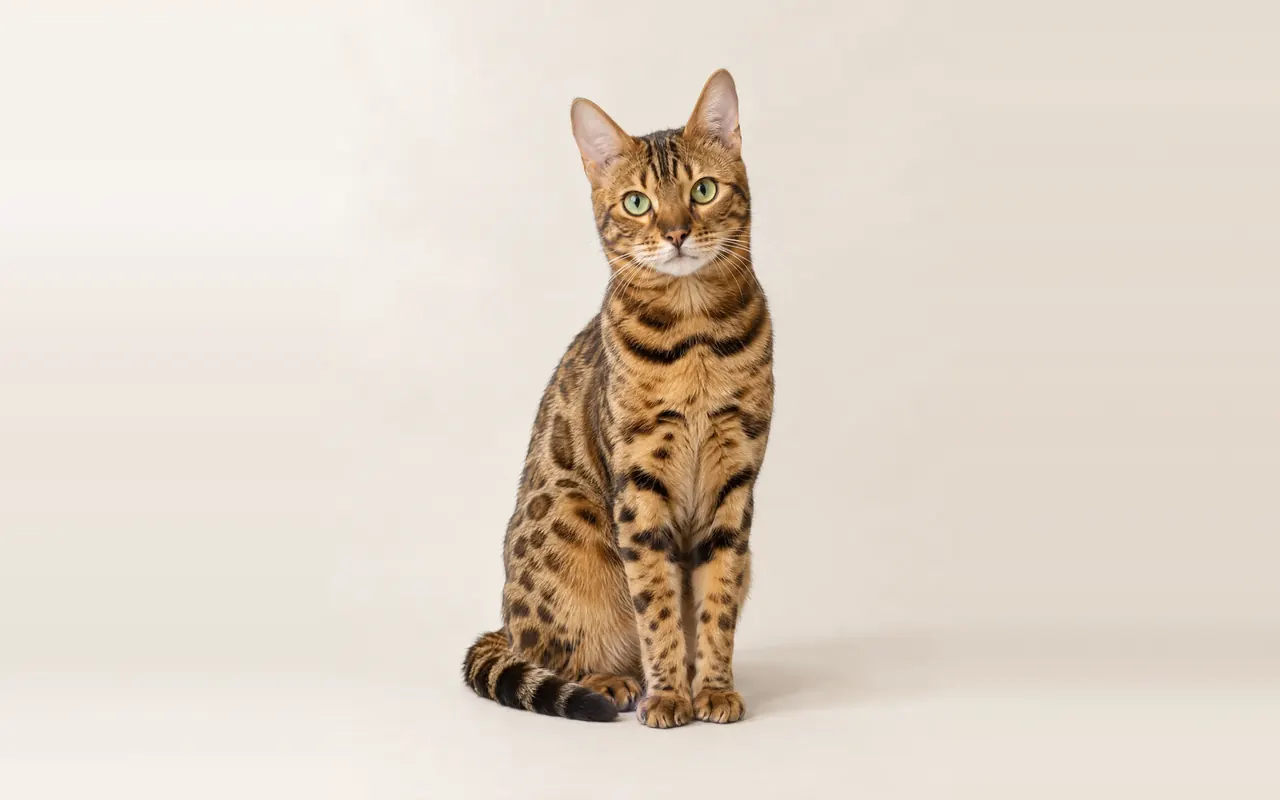
Cat breed
Bengal
From the United States, 8 to 20 pounds.
What a Bengal is really like
A Bengal is a small leopard in looks and a busy toddler in schedule. The spotted or marbled coat shimmers in the light, and the cat inside it wants to climb, chase, fetch and investigate from the moment it wakes up. If you picture a cat that naps all afternoon, picture a different cat.
Water is part of the fun for a lot of Bengals. They play with a dripping tap, fish toys out of the water bowl, pace the edge of the tub while you bathe and sometimes hop into the shower uninvited. Leave a glass of water on the coffee table and expect a paw in it.
They are full of ideas and need outlets for them: tall cat trees and wall shelves, puzzle feeders, fetch with a hair tie, a cat wheel or a harness walk for some. A Bengal with too little to do will open cupboards, unroll things and rearrange the shelves to keep itself entertained.
The facts
- Where it comes from
- United States
- Weight
- 8 to 20 pounds
Bengal owners will tell you
- Shut the bathroom door, or share your shower with a spotted cat.
- The top of the fridge was claimed on the first day.
- Everything on a shelf is an experiment in gravity waiting to happen.
- It fetches more reliably than plenty of dogs, and it knows it.
- You do not have a cat so much as a small, spotted roommate with a full calendar.
A day with a Bengal
An example, not a schedule: every home runs its own way.
- DawnParkour hour: a lap of the house by way of the couch back, the bookshelf and, briefly, the curtains.
- BreakfastFished out of a puzzle feeder one piece at a time, with a running commentary of chirps.
- MorningHelping at the bathroom sink: batting the running tap, soaking the counter and looking pleased about it.
- AfternoonA harness walk on the patio or a spin on the cat wheel, then a high perch for some serious bird watching.
- EveningFetch down the hallway with a crinkle ball, returned over and over until you give up first.
- NightFinally still, stretched along the top of the cat tree with one spotted leg dangling over the edge.
Before you choose
- Plan for vertical space and daily play. A Bengal needs climbing routes, scratching posts and real games every day, or it will invent its own on your furniture.
- Check local rules before you buy. Some states, cities and countries restrict or ban Bengals, especially early generations close to the wild leopard cat, and some leases do too.
- Most pet Bengals are many generations removed from the wild cat. Ask the breeder which generation a kitten is; early ones are rarer, pricier and the most often restricted.
- Water and Bengals mix. Expect splashes around bowls and sinks, wet paw prints across the counter and a cat that comes running at the sound of a tap.
- The short, sleek coat is the low-effort part: a quick brush or rubber mitt once a week keeps it glossy, and it sheds lightly.
- Ask the breeder about health screening for the kitten's parents, and ask a vet what to watch for in a Bengal.
History in brief
In 1963 a California breeder, Jean Mill, made the first known planned cross between a domestic cat and the Asian leopard cat, a small wild cat of South and Southeast Asia.
Serious work on the breed began in the 1980s, combining leopard cat hybrids with spotted domestic cats. A major registry accepted the Bengal as a new breed in 1986, and it spread worldwide from there.
The name comes from the leopard cat's scientific name, which refers to the Bengal region of South Asia.
Colors and looks
A long, muscular cat with a sleek short coat, spotted with rosettes or swirled in a marbled pattern. Many have glitter, a sheen on the fur that catches the light like gold or pearl dust. Snow Bengals are pale with darker markings.
Colors you will see
- Brown spotted
- Brown marbled
- Snow spotted
- Snow marbled
- Silver spotted
- Silver marbled
- Charcoal
- Blue
We haven't drawn a Bengal yetAsk for a Bengal and we'll email you when it's ready.
A Bengal's life stages
Every cat moves through the same stages, whatever its breed.
- KittenBirth to 1 year
- Young adult1 to 6 years
- Mature adult7 to 10 years
- SeniorOver 10 years
Stages from the American Animal Hospital Association life stage guidelines. How the life-stage calculator works
A Bengal's age in human years
On the same method as our cat age calculator.
| Age | In human years |
|---|---|
| 1 year | 15 |
| 2 years | 24 |
| 3 years | 28 |
| 5 years | 36 |
| 7 years | 44 |
| 10 years | 56 |
| 13 years | 68 |
| 16 years | 80 |
Questions people ask about the Bengal
Do Bengal cats like water?
Many do. Playing in sinks, pawing at taps and hopping into an empty tub are all common, and some will step into a running shower. It varies from cat to cat, but expect curiosity rather than fear.
How big do Bengal cats get?
Medium to large and very muscular. Adults run from about 8 to 20 lb, with males usually heavier, and the long, athletic body makes them look bigger still.
Are Bengal cats legal everywhere?
No. Some states, cities and countries restrict or ban them, particularly early generations. Check your local rules and your lease before you bring one home.
Can you walk a Bengal on a leash?
Plenty of owners do. Many Bengals take to a harness and enjoy a slow wander around the yard or a quiet street, which uses up some of that energy.
Do Bengals need a lot of attention?
Yes, mostly in the form of play. They want company, games and things to climb every day, and a Bengal with nothing to do will make its own fun.
Related breeds
The same size, or from the same country.



For your Bengal
Every cat is an individual. What we describe here is what is typical, from owners' experience and published breed descriptions, not a promise about any one cat. Meet the cat in front of you before you decide.
Breed facts: Wikidata, read 2026-10-03, which anyone may reuse.
Unlock unlimited calm listening, free
Quiet music for the hours your cat is home alone, and the occasional note about new designs.
Unlimited listening is unlocked on this device. The Soundtrack player is ready when you are. Open the Soundtrack player