Cat breed
Birman
From France.
What a Birman is really like
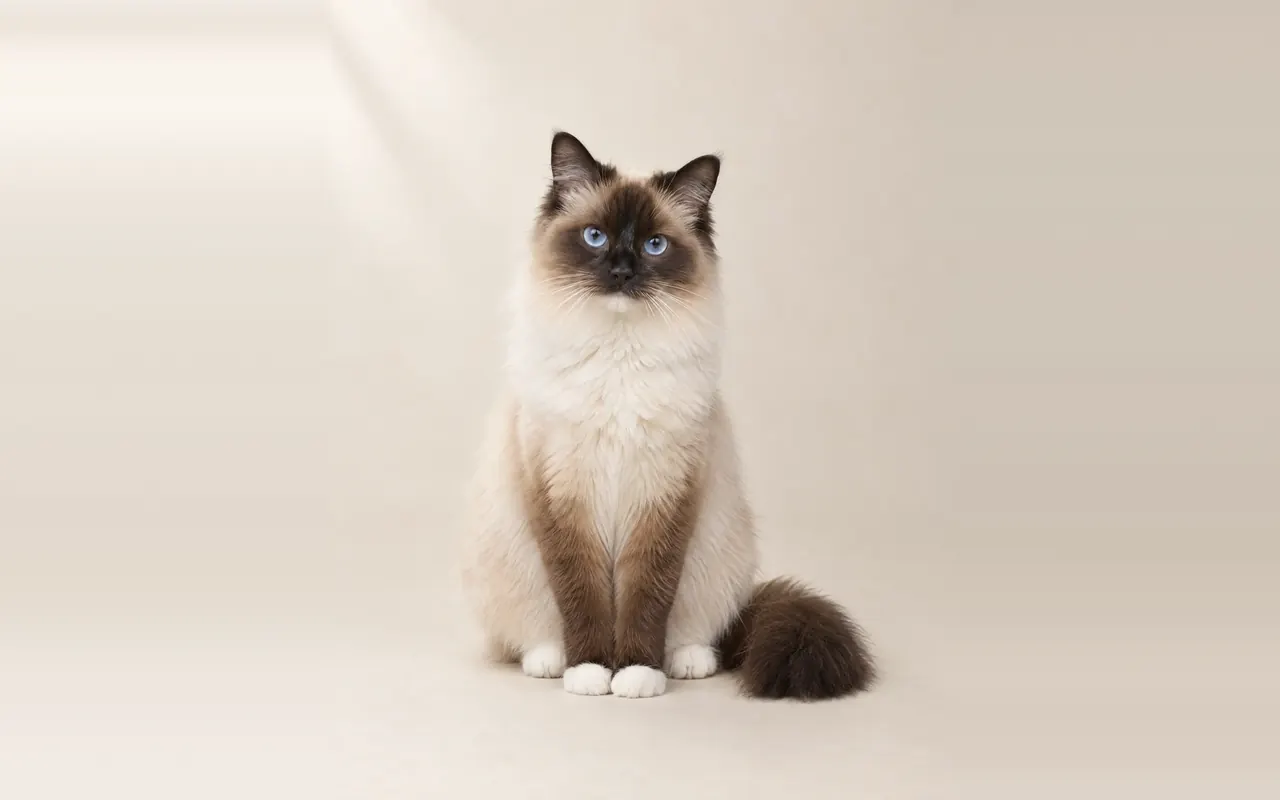
A Birman wears white gloves on all four paws, as if it dressed up to meet you, and it tends to act the part: interested in guests, content to be held and quietly present at the center of the household. Owners describe a cat that wants to be where the people are without making a fuss about it.
The voice is soft and the manner unhurried, but Birmans are not ornaments. They play fetch with hair ties, chase a ball down the hallway and come to see what the commotion is about when the doorbell rings. Plenty of owners keep two, and the pair spend their evenings washing each other's ears.
The silky coat is the other pleasant surprise. It is semi-long but has very little undercoat, so it tangles far less than it looks like it should. A comb once or twice a week usually keeps it in order, even through the spring shed.
The facts
- Where it comes from
- France
- Also called
- Sacred Cat of Burma
- Not to be confused with
- Burmese
Living with a Birman
Our ratings, worked out from what its sources say about its weight, its coat and how active it is. Every animal is an individual, so meet them before you decide.
- Coat
- Semi-long
- Grooming
- Brushing every week
- Shedding
- Some
Birman owners will tell you
- Those white socks stay cleaner than yours, somehow.
- A Birman meets the plumber at the door and supervises the whole repair.
- Hair ties vanish from the dresser and reappear, one at a time, at your feet.
- It starts purring before you have even finished sitting down.
A day with a Birman
An example, not a schedule: every home runs its own way.
- MorningA soft chirp at the bedroom door, then breakfast, then a slow wash of each white glove in turn.
- MiddayA nap in the laundry basket among the clean, still-warm towels, preferably the white ones.
- AfternoonFetch with a hair tie or a foil ball, dropped at your feet for another throw, then a stretch on the rug.
- EveningCurled against your hip on the sofa, one gloved paw resting on your arm, purring at a low hum.
- NightAsleep at the foot of the bed with its gloves tucked under, a soft weight against your feet.
Before you choose
- Birmans like company and tend to suit homes where someone is usually around and happy to have a cat at their elbow.
- The coat needs less work than most longhairs, with little undercoat to tangle, but a weekly comb and a bit more during the spring shed keep it smooth.
- Kittens are born pale, and their points darken over the first year or two while the white gloves stay white.
- They are moderate climbers and moderate players. A medium cat tree, a window perch and some daily play with a wand toy are usually plenty.
- Pet-quality Birmans may have gloves that are uneven or a little short. That matters in the show ring and not at all on your couch.
- Ask the breeder about health screening for the kitten's parents, and ask a vet what to watch for in a Birman.
History in brief
A favorite legend says the Birman began as a temple cat in Burma, given its golden coat, blue eyes and white paws by a goddess after it kept watch over an old priest.
The real record is less certain. The breed first appears in France, where it was recognized in 1925, and it nearly vanished during World War II, when only a pair of Birmans were left in Europe.
Breeders rebuilt it from that pair with help from other longhaired cats, and it reached Britain and America in the mid-1960s.
Colors and looks
A sturdy, medium-long body, a silky semi-long coat and a pale body with darker points, set off by deep blue eyes and pure white gloves on all four paws. On the back feet the white runs up the leg to a point, called the laces.
Colors you will see
- Seal point
- Blue point
- Chocolate point
- Lilac point
- Red point
- Cream point
- Seal tabby point
- Seal tortie point
We haven't drawn a Birman yetAsk for a Birman and we'll email you when it's ready.
A Birman's life stages
Every cat moves through the same stages, whatever its breed.
- KittenBirth to 1 year
- Young adult1 to 6 years
- Mature adult7 to 10 years
- SeniorOver 10 years
Stages from the American Animal Hospital Association life stage guidelines. How the life-stage calculator works
A Birman's age in human years
On the same method as our cat age calculator.
| Age | In human years |
|---|---|
| 1 year | 15 |
| 2 years | 24 |
| 3 years | 28 |
| 5 years | 36 |
| 7 years | 44 |
| 10 years | 56 |
| 13 years | 68 |
| 16 years | 80 |
Questions people ask about the Birman
Why do Birmans have white paws?
The white gloves are the breed's trademark, kept through careful breeding. Legend credits a temple goddess; the show ring simply asks that all four be white and as even as possible.
Do Birman cats mat easily?
Less than most longhairs. The silky coat has little undercoat, so a comb once or twice a week usually keeps it smooth, with extra attention when it sheds in spring.
Are Birmans vocal?
Not very. Most have a quiet voice and use it for small chirps and polite requests rather than long speeches.
Is a Birman the same as a Ragdoll?
No, though both have pointed coats and blue eyes. The Birman is a separate, older breed developed in France, with symmetrical white gloves and laces as its signature.
Do Birmans like to be held?
Many do, more than the average cat, and they tend to stay put on a lap. As always, it varies from one cat to the next.
More cat breeds
For your Birman
Every cat is an individual. What we describe here is what is typical, from owners' experience and published breed descriptions, not a promise about any one cat. Meet the cat in front of you before you decide.
Breed facts: Wikidata, read 2026-10-03, which anyone may reuse, and the breed's Wikipedia article, read 2026-10-08. The ratings in "Living with" are ours, from those facts.
Unlock unlimited calm listening, free
Quiet music for the hours your cat is home alone, and the occasional note about new designs.
Unlimited listening is unlocked on this device. The Soundtrack player is ready when you are. Open the Soundtrack player