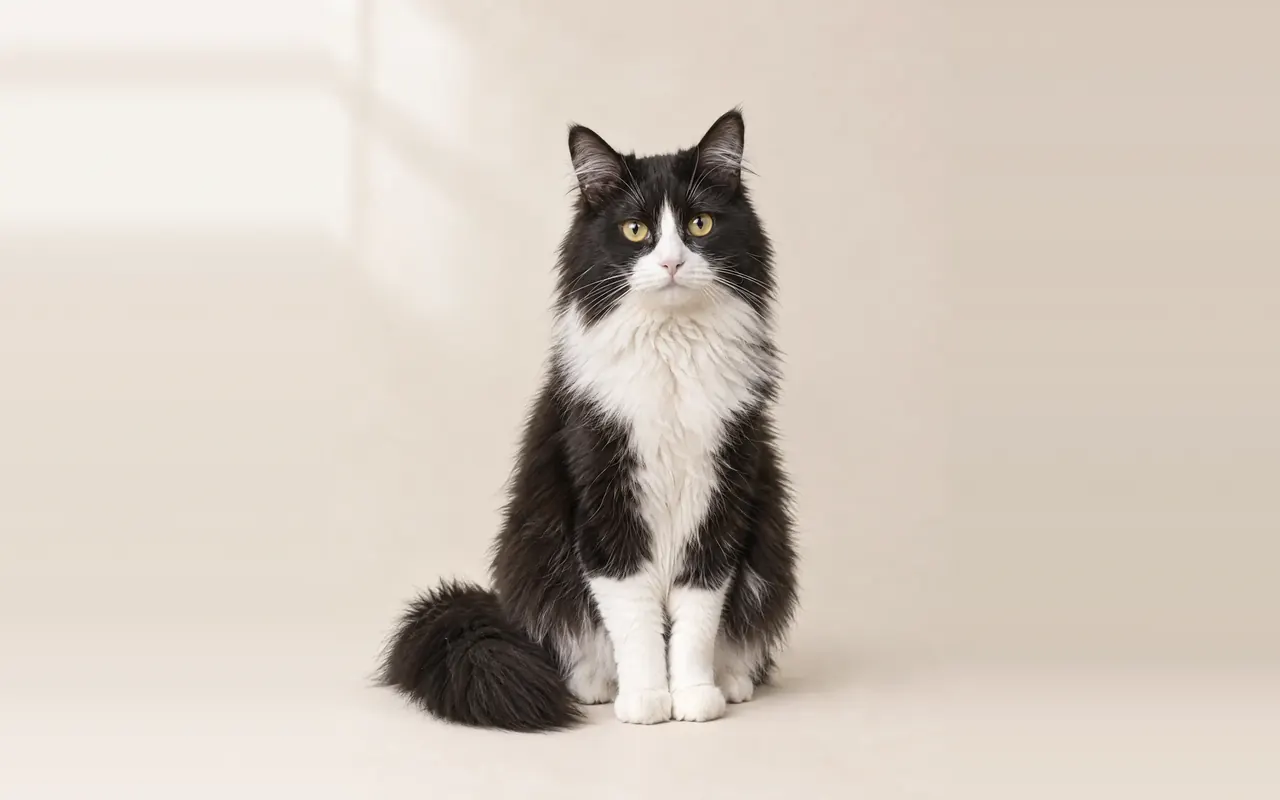
Domestic cat
Domestic Longhair
A domestic longhair is not a breed: it is a cat of mixed or unknown ancestry, described by its coat, so looks vary from cat to cat.
What a domestic longhair is really like
A domestic longhair is a mixed-ancestry cat with a long, flowing coat, the floof of the shelter world. It is not a breed, so no two look quite alike. Some resemble a Maine Coon, some a Persian, plenty look like nobody but themselves, and the personality under all that fur varies just as much.
Living with one means living with the coat. Long fur needs combing several times a week, more in spring, and tangles gather in places owners learn by heart: behind the ears, under the front legs, along the belly and in the britches. Make combing part of the evening on the couch and it can become a ritual the cat looks forward to.
Shelters take in many longhaired cats, from fluffy kittens to grown cats whose coats need a little catching up. Meeting an adult shows you both the finished coat and the habits, including the all-important question of how it feels about the comb.
The facts
Living with a Domestic Longhair
Our ratings, worked out from what its sources say about its weight, its coat and how active it is. Every animal is an individual, so meet them before you decide.
- Coat
- Depends on the cat: semi-long or long
- Grooming
- Weekly to regular
- Shedding
- Moderate to heavy
Domestic longhair owners will tell you
- Every visitor asks if it is a Maine Coon, and you have stopped correcting them.
- There is fur on the ceiling fan, and nobody can explain how it got there.
- Dark clothing is now a decision you make knowing the risks.
- It doubles in size when startled and again every winter.
A day with a domestic longhair
An example, not a schedule: every home runs its own way.
- MorningA long stretch, a full-body shake that releases a small cloud of fur, and a stroll to the bowl.
- MiddayAsleep on the darkest cushion in the house, chosen with care for maximum contrast.
- AfternoonA wrestling match with a kicker toy, back legs churning and fur flying in every direction.
- EveningComb time on your lap: the ruff and back go smoothly, and the belly is a negotiation.
- NightDraped across your feet like a purring winter blanket, warm and impossible to move.
Before you choose
- Budget grooming time: a few combing sessions a week, more in spring, plus a trim around the rear to keep the long fur there clean.
- Expect fur, in moderate to heavy amounts. A strong vacuum, lint rollers and washable throws over the furniture make life easier.
- A wide-toothed metal comb reaches down to the undercoat where tangles start; a brush alone often skims the surface.
- Look past the fluff. Personality varies widely, so spend time with the cat and ask about its habits before you choose.
- A longhaired adult from a shelter may arrive with a shaggy or clipped coat. With a steady combing routine, it usually grows back soft.
- Ask the shelter, rescue or breeder what they know about the cat's health, and ask a vet what to watch for.
History in brief
Longhaired cats were known in Turkey, Persia and Russia long before cat shows, and they reached Europe as prized imports in the 1600s. Over the centuries the long coat spread into ordinary house cats everywhere.
Today a domestic longhair is any long-coated cat without a pedigree. In the United States they rank among the most common house cats, and shelters see a steady stream of them.
Colors and looks
A long, soft coat that may be silky or woolly, usually with a full ruff, a plumed tail, fluffy britches and tufts between the toes. Bodies range from slight to large and faces from pointed to round, so two longhairs can look entirely different.
Colors you will see
- Brown tabby
- Silver tabby
- Orange
- Black
- White
- Blue
- Smoke
- Calico
- Tortoiseshell
- Black and white
- Cream
- Dilute tortie
Most common names for a Domestic Longhair
In the pet license records we use, 806 cats are listed as a Domestic Longhair or a Domestic Longhair mix. These are their most common names.
From pet license records published by New York City, Seattle, Cambridge in Massachusetts, and Allegheny County in Pennsylvania. How the names data works
Eight ways we draw a Domestic Longhair
Each one prints on a poster, a bandana, a bed, a mat and more. Pick a style to see it on a poster.
 Retro badge
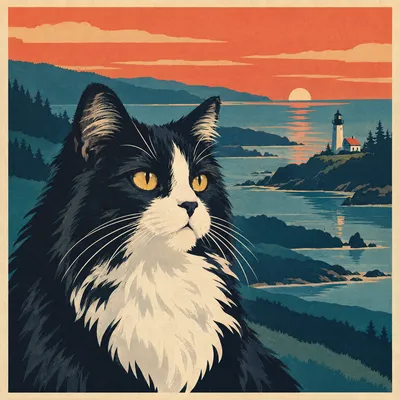 National park poster
 Woodblock print
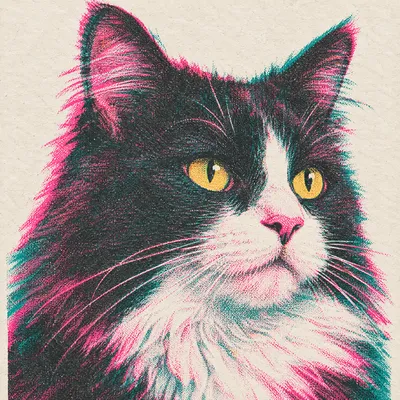 Risograph print
 Art nouveau
 Tattoo flash
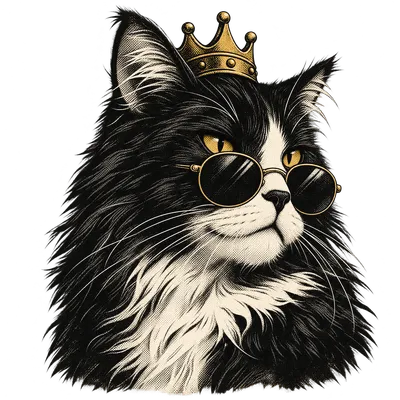 Crown and shades
 Varsity crest
Not your cat's color?
A Domestic Longhair's life stages
Every cat moves through the same stages, whatever its breed.
- KittenBirth to 1 year
- Young adult1 to 6 years
- Mature adult7 to 10 years
- SeniorOver 10 years
Stages from the American Animal Hospital Association life stage guidelines. How the life-stage calculator works
A Domestic Longhair's age in human years
On the same method as our cat age calculator.
| Age | In human years |
|---|---|
| 1 year | 15 |
| 2 years | 24 |
| 3 years | 28 |
| 5 years | 36 |
| 7 years | 44 |
| 10 years | 56 |
| 13 years | 68 |
| 16 years | 80 |
Questions people ask about the domestic longhair
Is a domestic longhair a Maine Coon?
Usually not. Many longhaired shelter cats look like Maine Coons, and some get listed as mixes, but without a pedigree there is no way to know. A domestic longhair is simply a long-coated cat of mixed ancestry.
How often should you comb a domestic longhair?
Several times a week for most, and daily during heavy shedding. Start with the belly, the armpits and behind the ears, where mats form first.
Do domestic longhairs shed a lot?
Yes, more than shorthairs. A long coat drops fur all year and sheds hardest in spring, and regular combing catches loose hair before it reaches your couch.
Do longhaired cats need baths?
Rarely. Most keep themselves clean with help from regular combing. An occasional bath or a tidy trim around the rear helps when the coat gets messy.
More cat breeds
For your Domestic Longhair
Every cat is an individual. What we describe here is what is typical, from owners' experience and published breed descriptions, not a promise about any one cat. Meet the cat in front of you before you decide.
Breed facts: Wikidata, read 2026-10-03, which anyone may reuse, and the breed's Wikipedia article, read 2026-10-08. The ratings in "Living with" are ours, from those facts.
Unlock unlimited calm listening, free
Quiet music for the hours your cat is home alone, and the occasional note about new designs.
Unlimited listening is unlocked on this device. The Soundtrack player is ready when you are. Open the Soundtrack player