Cat breed
Norwegian Forest Cat
From Norway, 8 to 20 pounds.
What a Norwegian Forest Cat is really like
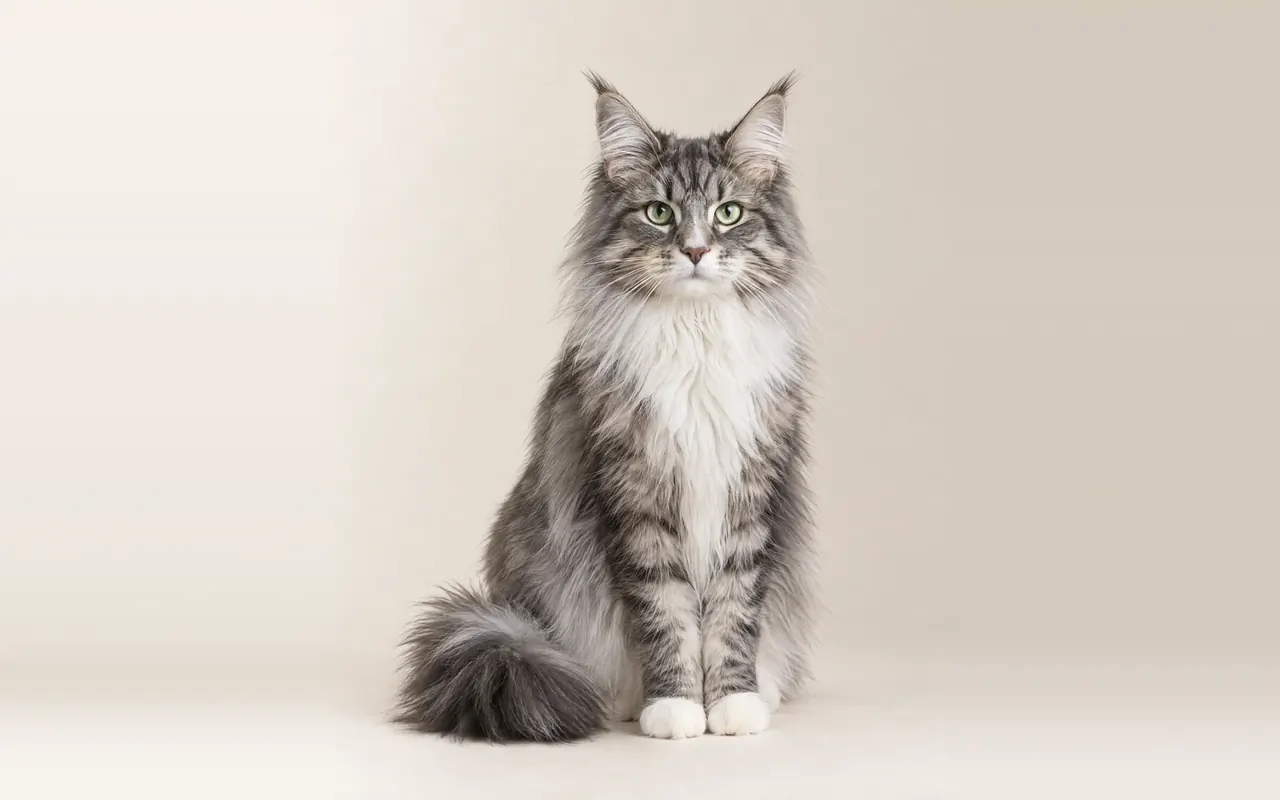
A Norwegian Forest Cat looks built for a winter that never ends: a long, water-shedding top coat over a woolly undercoat, a mane around the neck, tufted ears and a tail like a fox's brush. Owners call them Wegies, and all that fluff makes them look even bigger than they are.
They are climbers above all. A Wegie heads for the top of the tallest cat tree or bookcase, and thanks to strong claws it can come back down headfirst in a way that startles first-time owners. Give one some height and it will spend half the day surveying the household from above.
Indoors they tend to be relaxed and sociable without being clingy: content to sit near you, keen on a good game of chase, then off about their own business. They mature slowly, often taking around five years to fill out, and many keep a playful streak well into adulthood.
The facts
- Where it comes from
- Norway
- Weight
- 8 to 20 pounds
- Also called
- Wegie
Living with a Norwegian Forest Cat
Our ratings, worked out from what its sources say about its weight, its coat and how active it is. Every animal is an individual, so meet them before you decide.
- Size
- Large
- Coat
- Long
- Grooming
- Regular brushing, and trims for some coats
- Shedding
- A lot
- Activity
- Higher
Norwegian Forest Cat owners will tell you
- The spring shed fills a grocery bag, and somehow the cat looks exactly the same size.
- It comes down the cat tree headfirst, like a squirrel wearing a lion costume.
- The cat tree is base camp; the summit is the top of the wardrobe.
- Snow falling past the window earns a long, approving stare.
A day with a Norwegian Forest Cat
An example, not a schedule: every home runs its own way.
- DawnStraight up to the top of the cat tree to inspect the morning view, ear tufts first.
- BreakfastA steady, unhurried eater, followed by a long and thorough grooming session on the windowsill.
- MiddayAsleep up high, draped over the edge of a shelf with that big tail hanging down like a bell pull.
- AfternoonChase and pounce with a wand toy, then a climb, then more chase, in short and energetic bursts.
- EveningPerched on the arm of the couch beside you, close at hand but not quite in your lap.
Before you choose
- Plan for height. Sturdy floor-to-ceiling cat trees, wall shelves and window perches matter more to a Wegie than any toy.
- The double coat looks like a lot of work but mostly looks after itself. Comb it weekly, then daily during the big seasonal shed, when the undercoat comes out in clumps.
- They grow slowly and may not look fully adult until around five, so a young Wegie keeps getting bigger and broader for years.
- Expect fur on a seasonal schedule. Shedding is moderate most of the year and heavy once or twice a year, so a strong vacuum earns its place.
- They enjoy company and play but also like a quiet, high perch to retreat to when the house gets loud, so give them one.
- Ask the breeder about health screening for the kitten's parents, and ask a vet what to watch for in a Norwegian Forest Cat.
History in brief
The skogkatt, or forest cat, has lived in Norway for centuries, probably descended from cats that arrived with Viking-age traders and settlers and grew thick coats to cope with northern winters.
Norse folk tales describe a fairy cat of the mountains that could scale bare rock, and anyone who watches a Wegie climb a bookcase finds the legend easy to believe.
Cross-breeding during World War II nearly lost the breed. A club founded in Oslo in 1938 led its recovery, King Olav V named it Norway's national cat, and it joined registries across Europe from the 1970s and in America after that.
Colors and looks
A big, strong cat with long legs, the back pair a little longer than the front, a triangular face with a straight profile and tufted ears. The glossy outer coat sheds rain and snow, the undercoat is thick and woolly, and the mane and britches are fullest in winter.
Colors you will see
- Brown tabby
- Silver tabby
- Black
- White
- Blue
- Red
- Cream
- Tortoiseshell
- Black and white
- Calico
We haven't drawn a Norwegian Forest Cat yetAsk for a Norwegian Forest Cat and we'll email you when it's ready.
A Norwegian Forest Cat's life stages
Every cat moves through the same stages, whatever its breed.
- KittenBirth to 1 year
- Young adult1 to 6 years
- Mature adult7 to 10 years
- SeniorOver 10 years
Stages from the American Animal Hospital Association life stage guidelines. How the life-stage calculator works
A Norwegian Forest Cat's age in human years
On the same method as our cat age calculator.
| Age | In human years |
|---|---|
| 1 year | 15 |
| 2 years | 24 |
| 3 years | 28 |
| 5 years | 36 |
| 7 years | 44 |
| 10 years | 56 |
| 13 years | 68 |
| 16 years | 80 |
Questions people ask about the Norwegian Forest Cat
What is the difference between a Norwegian Forest Cat and a Maine Coon?
They look alike at a glance, but the Wegie has a triangular head with a straight profile, while the Maine Coon has a squarer muzzle and a more rectangular head. Both are big, long-haired climbers from cold places.
How big do Norwegian Forest Cats get?
Large. Adults run from about 8 to 20 lb, with males usually heavier, and the thick coat makes them look bigger still. Many take about five years to fill out completely.
Do Norwegian Forest Cats shed a lot?
Yes, especially once or twice a year when the undercoat drops all at once. Between those sheds the coat is fairly easy, and a weekly comb keeps it tidy.
Do Norwegian Forest Cats like to climb?
Very much. They are strong, sure-footed climbers and like the highest perch on offer. Tall, sturdy cat trees and wall shelves give them somewhere approved to go.
Are Norwegian Forest Cats lap cats?
Some are, many are not. They tend to stay near their people, beside you rather than on you, and come for attention on their own terms.
More cat breeds


For your Norwegian Forest Cat
Every cat is an individual. What we describe here is what is typical, from owners' experience and published breed descriptions, not a promise about any one cat. Meet the cat in front of you before you decide.
Breed facts: Wikidata, read 2026-10-03, which anyone may reuse, and the breed's Wikipedia article, read 2026-10-08. The ratings in "Living with" are ours, from those facts.
Unlock unlimited calm listening, free
Quiet music for the hours your cat is home alone, and the occasional note about new designs.
Unlimited listening is unlocked on this device. The Soundtrack player is ready when you are. Open the Soundtrack player