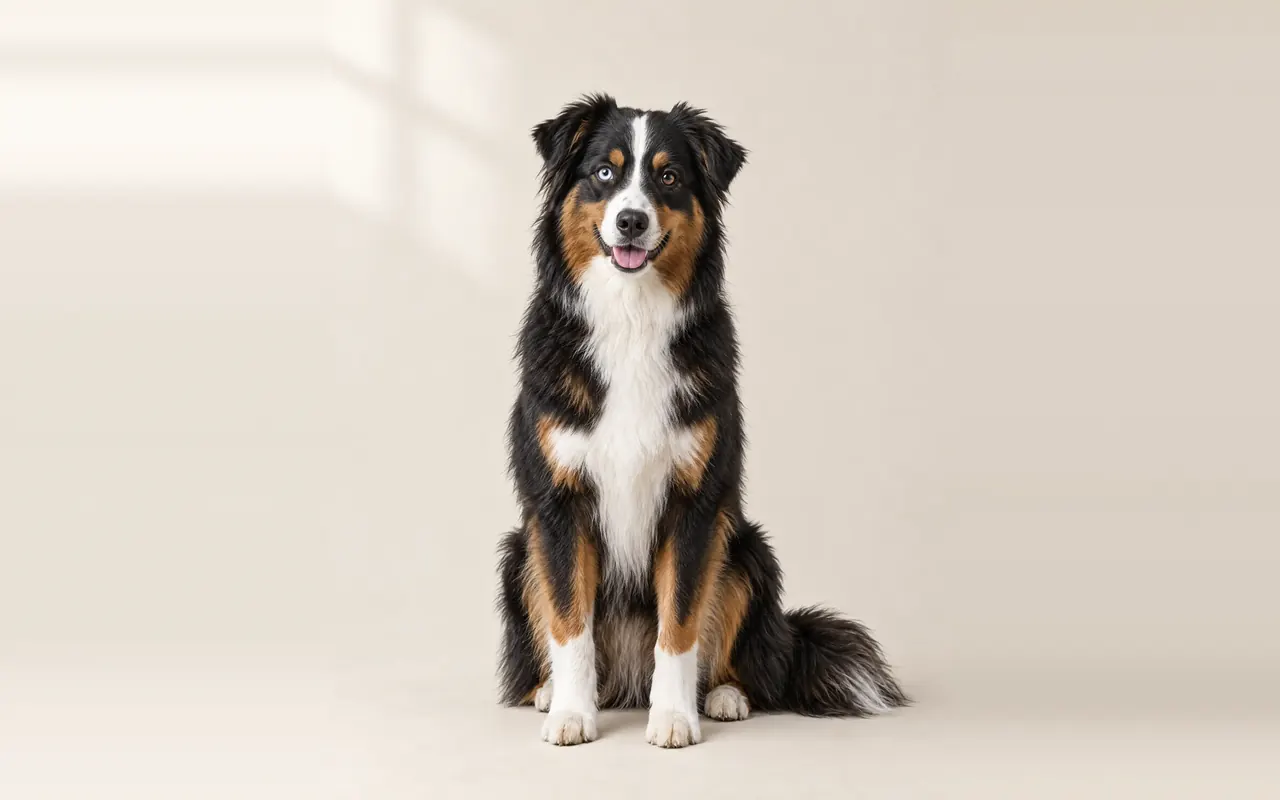
Dog breed
Australian Shepherd
From the United States and Australia, 18 to 23 inches at the shoulder and 35 to 70 pounds.
What an Australian Shepherd is really like
An Australian Shepherd is a ranch dog that ended up in the suburbs, and it has not forgotten. Aussies watch everything, count everyone and like the household arranged the way they prefer, which can mean circling people in the yard, nudging the heels of anyone who drifts away from the group and steering the cat into the kitchen.
They are shadows by nature. An Aussie wants to be where you are, doing what you are doing, preferably with a task of its own, and it greets its people with a wiggle so strong that a short tail cannot keep up and the whole body joins in. Owners call it the Aussie wiggle. With strangers, many take a long look before deciding to say hello.
Energy is the big question. Aussies were bred to work livestock from sunrise to sunset, and a stroll around the block barely counts. They thrive on running, hiking, fetch, herding lessons and dog sports, plus puzzles that make them think. An Aussie with too little to do invents its own projects, such as digging a trench or barking at the neighbor's sprinkler.
The facts
- Where it comes from
- United States and Australia
- Height at the shoulder
- 18 to 23 inches
- Weight
- 35 to 70 pounds
- Typical lifespan
- 13 to 15 years
- Also called
- Aussie
- American Kennel Club
- A recognized breed
Living with a Australian Shepherd
Our ratings, worked out from what its sources say about its weight, its coat and what it was bred for. Every animal is an individual, so meet them before you decide.
- Bred for
- Herding sheep
- Size
- Medium to large
- Coat
- A long double coat
- Grooming
- Regular brushing, and trims for some coats
- Shedding
- A lot
- Exercise
- Lots: long walks, runs or a job to do
Breeds compared: Australian Shepherd vs Labrador Retriever · Australian Shepherd vs Golden Retriever · Australian Shepherd vs German Shepherd
Australian Shepherd owners will tell you
- Every trip to the kitchen comes with an escort and a supervisor.
- One blue eye, one brown eye, and both are watching you.
- Guests get herded into the living room and are not allowed to wander.
- A ten-mile hike is a warm-up, and the Aussie would like to know what is next.
- The fur tumbleweeds are merle now, and they match the rug.
A day with an Australian Shepherd
An example, not a schedule: every home runs its own way.
- SunriseAlready awake and watching the bedroom door, ready to start the shift.
- MorningA run, a hike or a game with a flying disc in the park, with the Aussie leaping to snatch it from the air.
- MiddaySupervising the household: who is in which room, where the cat went and why that door is closed.
- AfternoonBrain work: a puzzle feeder, a sniffing game or a new trick, which an Aussie often picks up faster than its owner expected.
- EveningGathering everyone into one room, then finally flopping flat out, nose pointed at whoever is likely to move next.
Before you choose
- Exercise is non-negotiable. Plan on at least an hour of real activity most days, more for working lines, plus games that challenge the brain.
- Herding comes naturally, which can mean circling, staring and nipping at the heels of running people, bikes and other pets. It is instinct rather than mischief, and it needs an outlet.
- The double coat sheds heavily all year and blows out about twice a year. Weekly brushing, more during the heavy spells, keeps the hair under control.
- Aussies attach strongly to their people and like to be part of everything. They tend to suit active households that want a dog along for the hike, the errand and the yard work.
- Many are reserved with new people at first. Expect a dog that watches a stranger for a while before deciding they are worth a greeting.
- If a smaller dog appeals, the Miniature American Shepherd is its own breed, not simply a small Aussie, so ask which one a breeder raises.
- Ask the breeder about health screening for the puppy's parents, and ask a vet what to watch for in an Australian Shepherd.
History in brief
Despite the name, the breed was shaped in the American West. California ranchers developed it in the 1800s from herding dogs that arrived along with flocks of sheep, including collies shipped from Australia and New Zealand, which is likely where the name came from.
Aussies stayed working ranch dogs until the mid-1900s, when a rodeo performer named Jay Sisler toured the western states with a troupe of Aussies doing tricks, and audiences began asking where to find one.
A breed club soon followed, and today Aussies still work cattle and sheep, run in agility and herding trials, and do search work, as well as supervising a great many backyards.
Colors and looks
A medium-sized, athletic dog with a medium-length double coat, a full mane and feathered legs, and a tail that may be long or naturally short. The eyes can be brown, blue, amber or one of each, and some have flecks or two colors within a single eye.
Colors you will see
- Blue merle
- Red merle
- Black
- Red
- Black tricolor
- Red tricolor
Most common names for a Australian Shepherd
In the pet license records we use, 3,185 dogs are listed as a Australian Shepherd or a Australian Shepherd mix. These are their most common names.
Names that lean Australian Shepherd
Each of these is more common among Australian Shepherd dogs than among all the dogs whose breed we can read in the records.
From pet license records published by New York City, Seattle, Cambridge in Massachusetts, and Allegheny County in Pennsylvania. How the names data works
Eight ways we draw a Australian Shepherd
Each one prints on a poster, a bandana, a bed, a mat and more. Pick a style to see it on a poster.
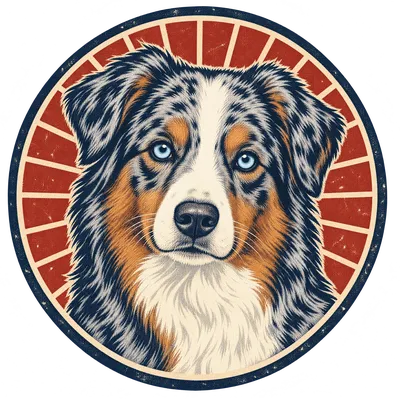 Retro badge
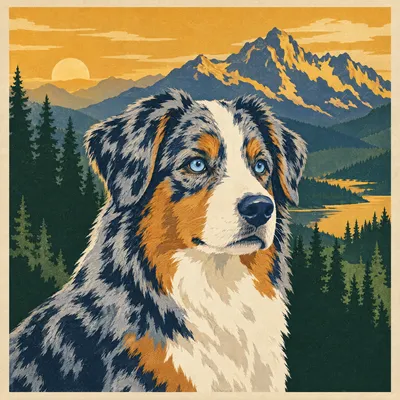 National park poster
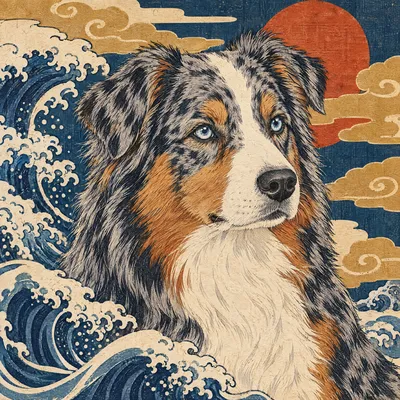 Woodblock print
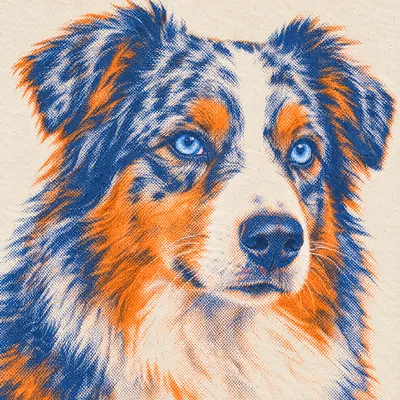 Risograph print
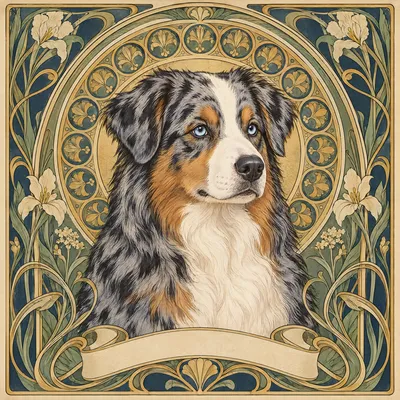 Art nouveau
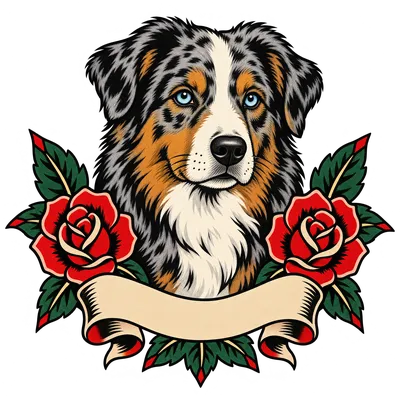 Tattoo flash
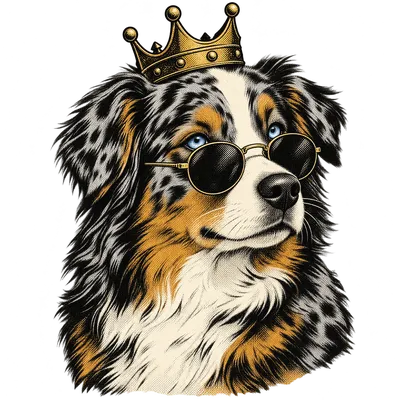 Crown and shades
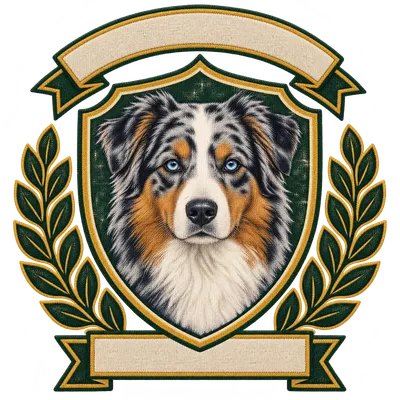 Varsity crest
Not your dog's color?
A Australian Shepherd's life stages
A Australian Shepherd is a medium to large dog by its recorded weight; the stages below follow the large band, and the age the senior years may start depends on size.
- PuppyBirth to 6 months
- Puppy or young adult6 to 9 months
- Young adult9 months to 3 years
- Young or mature adult3 to 4 years
- Mature adult4 to 7 years
- Mature adult or seniorFrom 7 years
Stages from the American Animal Hospital Association life stage guidelines. How the life-stage calculator works
A Australian Shepherd's age in human years
A Australian Shepherd's recorded weight spans medium to large dogs; this table uses the large band, on the same method as our dog age calculator.
| Age | In human years |
|---|---|
| 1 year | 15 |
| 2 years | 24 |
| 3 years | 30 |
| 5 years | 42 |
| 7 years | 54 |
| 10 years | 72 |
| 13 years | 90 |
| 16 years | 108 |
Questions people ask about the Australian Shepherd
How big do Australian Shepherds get?
Males usually stand about 20 to 23 inches and females about 18 to 21 inches at the shoulder, with most adults weighing somewhere between 35 and 70 lb.
Are Australian Shepherds actually from Australia?
No. The breed was developed on ranches in the western United States. The name most likely comes from sheep, and the herding dogs that came with them, arriving in California from Australia.
Why do Australian Shepherds have different colored eyes?
Eye color varies widely in the breed, and blue, brown, amber and mixed eyes all appear, often alongside merle coats. One blue eye and one brown is common and fully accepted in the breed standard.
Do Australian Shepherds shed a lot?
Yes. The double coat sheds steadily and sheds hard about twice a year. A weekly brush, and daily brushing during the heavy spells, keeps the floor from turning into a second rug.
Do Aussies try to herd people?
Often. Many circle, stare at or nudge people, bikes and other pets that move fast, and some nip at heels. It is herding instinct, and owners usually give it a better outlet through games, dog sports or herding lessons.
Related breeds
The same size, or from the same country.
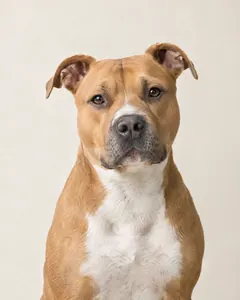
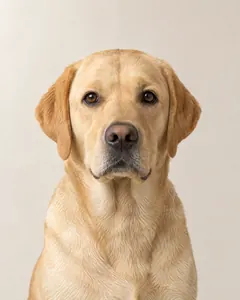
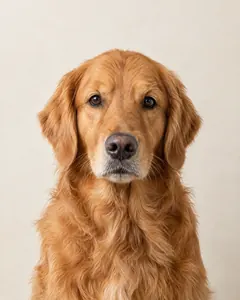
For your Australian Shepherd
Every dog is an individual. What we describe here is what is typical, from owners' experience and published breed descriptions, not a promise about any one dog. Meet the dog in front of you before you decide.
Breed facts: Wikidata, read 2026-10-03, which anyone may reuse, and the breed's Wikipedia article, read 2026-10-08. The ratings in "Living with" are ours, from those facts.
Unlock unlimited calm listening, free
Quiet music for the hours your dog is home alone, and the occasional note about new designs.
Unlimited listening is unlocked on this device. The Soundtrack player is ready when you are. Open the Soundtrack player