Dog breed
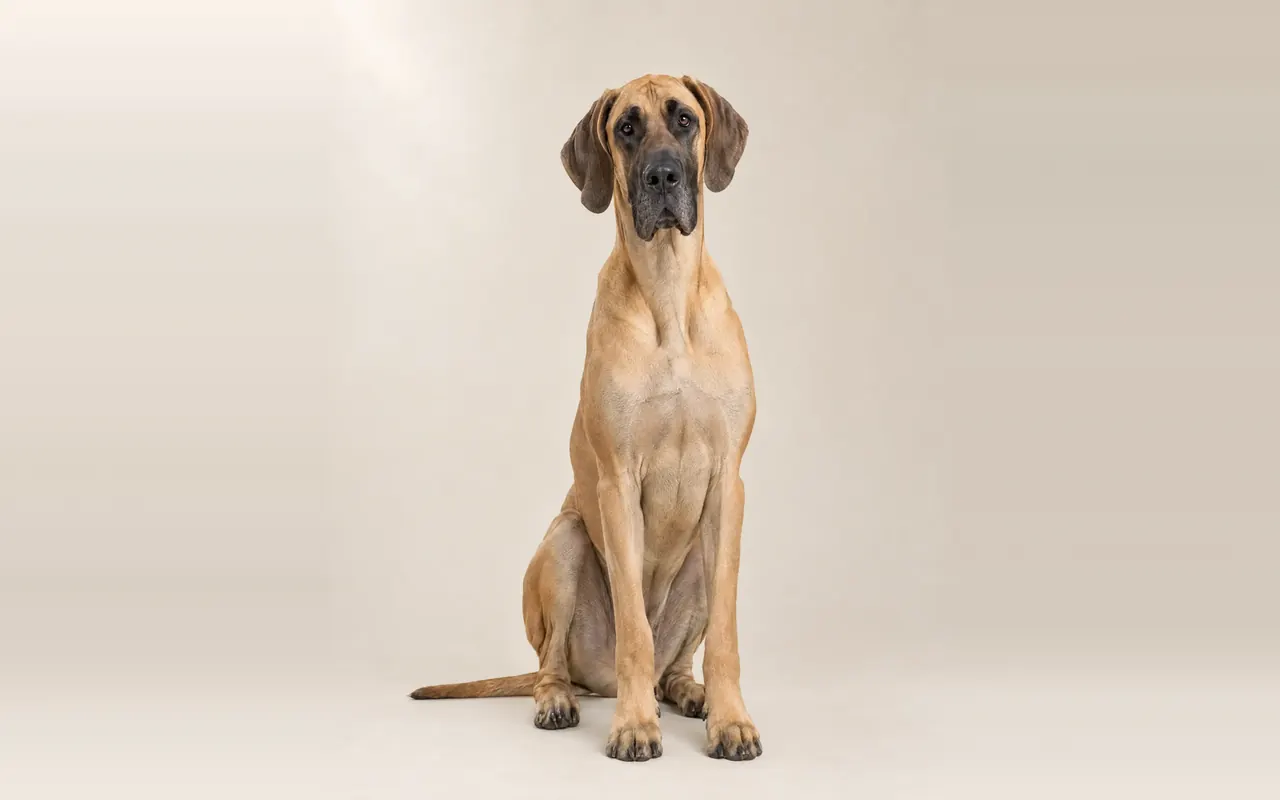
Great Dane
From Germany, 28 to 35 inches at the shoulder and 110 to 198 pounds.
What a Great Dane is really like
A Great Dane does not know it is big. It will try to sit in your lap, curl up in the cat's bed and squeeze in behind you on an armchair, and it looks honestly puzzled when none of this works out. Most of the day goes to lounging: Danes are expert sofa occupiers, and a grown one fills the whole thing with its legs hanging off the end.
Daily life gets rearranged around the size. A Dane's nose reaches the kitchen counter without even trying, so the sandwich you set down is now at dog eye level. A happy tail at coffee table height can sweep the table clear in one wag. Doorways get crowded, the back seat of a small sedan stops being an option, and you start judging cars by whether a dog the size of a pony fits in the back.
Under all that size is a surprisingly low-key housemate. Adult Danes are not high-energy dogs: a couple of good walks and room to stretch out are usually plenty, and they will happily nap through the afternoon. Puppies are another story, growing at a startling pace into gangly, clumsy teenagers with no idea where their legs end.
The facts
- Where it comes from
- Germany
- Height at the shoulder
- 28 to 35 inches
- Weight
- 110 to 198 pounds
- Typical lifespan
- around 9 years
- Litter size
- around 7 puppies
- Also called
- German Mastiff and Deutsche Dogge
- American Kennel Club
- A recognized breed
Living with a Great Dane
Our ratings, worked out from what its sources say about its weight, its coat and what it was bred for. Every animal is an individual, so meet them before you decide.
- Bred for
- Guarding estates and hunting large game
- Size
- Giant
- Coat
- Short and smooth
- Grooming
- A quick brush now and then
- Shedding
- Some
- Exercise
- Moderate: a good walk every day, and play
Great Dane owners will tell you
- It is a lap dog. It just needs a much bigger lap.
- Nothing on the kitchen counter is out of reach, and the Dane knows it.
- You do not choose your next car anymore; the dog does.
- One happy wag and the coffee table is clear.
- Lying on the sofa now means lying under the Dane.
A day with a Great Dane
An example, not a schedule: every home runs its own way.
- MorningA long, lanky stretch that fills the hallway, then a walk at a stately pace, with stops to be admired by strangers.
- BreakfastGone in a few big mouthfuls, then a long drink and a dripping chin wiped on the nearest pair of pants.
- MiddayA nap. Then another nap, on a different sofa, after a deep sigh about the first one.
- AfternoonA short game in the yard and a few laps at a gallop, then back inside to stretch out across the entire floor.
- EveningDraped over as much of the sofa as possible, with a heavy head resting on whoever is left.
- NightAsleep on a bed the size of a twin mattress, or on yours, if nobody objects too strongly.
Before you choose
- Measure your car. A grown Dane needs the back of an SUV, a minivan or a wagon, and getting in and out may take a ramp or a strong helper.
- Budget for big: the food bill, a crate the size of a closet, a bed fit for a person and boarding priced for a giant.
- A grown Dane is over the weight limit many leases set, so read the pet clause before you sign.
- Nothing below shoulder height is out of reach. Counters, tabletops and the sink are at a Dane's eye level, so food goes away or up high.
- Puppies grow fast and clumsy. Expect a lanky teenager that bumps into lamps and small visitors without meaning to, and keep the leash in strong hands.
- The coat is short and easy, but there is a lot of dog under it, so the shedding adds up. Many Danes drool too, especially the looser-lipped ones.
- Ask the breeder about health screening for the puppy's parents, and ask a vet what to watch for in a Great Dane.
History in brief
Despite the name, the Great Dane is German. Its ancestors were big hunting dogs kept by German nobles for chasing wild boar, bear and deer, and the favorites slept indoors at night as chamber dogs, wearing ornate collars.
A committee in Berlin settled the German name, Deutsche Dogge, in 1878. English speakers had long called the dog a Dane, or a German boarhound, and the Danish label stuck even though nobody is quite sure how it started.
The breed was already in the United States by the late 1800s, and the American Kennel Club recognized it in 1887.
Colors and looks
Tall, square and elegant, with a long rectangular head, a deep chest and a short, glossy coat. Harlequins are white with torn black patches, and mantles are black with a white collar, chest and feet, as if dressed for a formal dinner.
Colors you will see
- Fawn
- Brindle
- Black
- Blue
- Harlequin
- Mantle
- Merle
Most common names for a Great Dane
In the pet license records we use, 673 dogs are listed as a Great Dane or a Great Dane mix. These are their most common names.
From pet license records published by New York City, Seattle, Cambridge in Massachusetts, and Allegheny County in Pennsylvania. How the names data works
We haven't drawn a Great Dane yetAsk for a Great Dane and we'll email you when it's ready.
A Great Dane's life stages
A Great Dane is a giant dog by its recorded weight, and the age the senior years may start depends on size.
- PuppyBirth to 6 months
- Puppy or young adult6 to 9 months
- Young adult9 months to 3 years
- Young or mature adult3 to 4 years
- Mature adult4 to 7 years
- Mature adult or seniorFrom 7 years
Stages from the American Animal Hospital Association life stage guidelines. How the life-stage calculator works
A Great Dane's age in human years
For a giant dog, on the same method as our dog age calculator.
| Age | In human years |
|---|---|
| 1 year | 15 |
| 2 years | 24 |
| 3 years | 31 |
| 5 years | 45 |
| 7 years | 59 |
| 10 years | 80 |
| 13 years | 101 |
| 16 years | 122 |
Questions people ask about the Great Dane
How big do Great Danes get?
Males usually stand about 30 to 32 inches at the shoulder and weigh 140 to 175 lb; females about 28 to 30 inches and 110 to 140 lb. Up on their hind legs, many are taller than the people they live with.
Can a Great Dane live in an apartment?
Many do. Adult Danes are fairly low-key indoors, so floor space matters less than you might expect. The bigger questions are stairs, elevators and whether the lease allows a dog this large.
Do Great Danes shed?
Yes, a moderate amount. The coat is short, but it covers a lot of dog, so a weekly brush keeps the hair on the Dane and off the furniture.
Do Great Danes drool?
Some do, especially those with looser lips. Expect a damp chin after drinking and a few strings at dinnertime; owners keep a towel handy.
Are Great Danes from Denmark?
No. The breed comes from Germany, where it is called the Deutsche Dogge. The English name stuck long ago, and nobody is quite sure why.
Related breeds
The same size, or from the same country.

For your Great Dane
Every dog is an individual. What we describe here is what is typical, from owners' experience and published breed descriptions, not a promise about any one dog. Meet the dog in front of you before you decide.
Breed facts: Wikidata, read 2026-10-03, which anyone may reuse, and the breed's Wikipedia article, read 2026-10-08. The ratings in "Living with" are ours, from those facts.
Unlock unlimited calm listening, free
Quiet music for the hours your dog is home alone, and the occasional note about new designs.
Unlimited listening is unlocked on this device. The Soundtrack player is ready when you are. Open the Soundtrack player