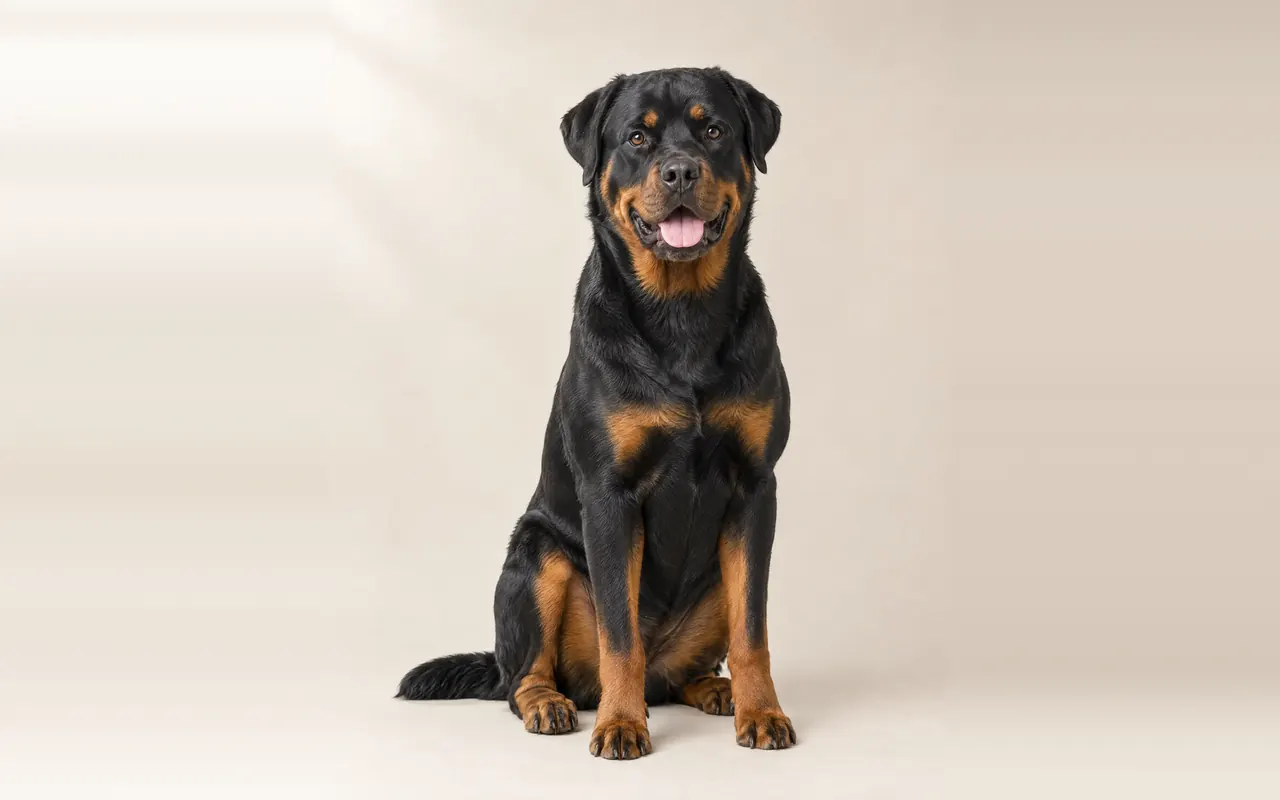
Dog breed
Rottweiler
From Germany, 22 to 27 inches at the shoulder and 93 to 110 pounds.
What a Rottweiler is really like
Living with a Rottweiler means living with a large, solid shadow. A Rottie tends to pick its people and stay within arm's reach: lying across the kitchen doorway while you cook, leaning a hundred-pound body against your knees during a phone call, parking on your foot so you cannot wander off without it.
Then there is the rumble. Many Rottweilers make a low, purring grumble when they are content, during an ear scratch or a good long lean, and new owners are often startled to learn it is the happiest sound the dog makes. Add the wiggle of a docked tail or the sweep of a natural one, and you have a big dog that is far sillier at home than its serious face suggests.
Rottweilers were bred to drive cattle and pull carts, and they still like a task. Many take to carrying things, nose games, herding events or pulling a small cart, and most enjoy steady daily walks more than wild sprints. They are slow to grow up, often staying goofy and gangly into their second or third year, and they grow into a great deal of dog.
The facts
- Where it comes from
- Germany
- Height at the shoulder
- 22 to 27 inches
- Weight
- 93 to 110 pounds
- Litter size
- around 8 puppies
- Named after
- Rottweil
- Also called
- Rottie
- American Kennel Club
- A recognized breed
Living with a Rottweiler
Our ratings, worked out from what its sources say about its weight, its coat and what it was bred for. Every animal is an individual, so meet them before you decide.
- Bred for
- Driving and guarding cattle
- Size
- Large to giant
- Coat
- A double coat, short to medium
- Grooming
- A quick brush now and then
- Shedding
- A lot
- Exercise
- Moderate: a good walk every day, and play
Rottweiler owners will tell you
- That deep rumble while you scratch its ears is the Rottie version of a purr.
- Moving a sleeping Rottweiler off the bed is a job for two people and a bribe.
- A docked-tail wiggle involves the entire back half of the dog.
- The drool arrives the moment you put on dark pants.
A day with a Rottweiler
An example, not a schedule: every home runs its own way.
- MorningA long, steady walk with plenty of sniffing, and frequent glances back to check that you are still right there.
- BreakfastEaten in short order, then a slow lap of the kitchen with a hopeful drip from the jowls.
- MiddayA little work: a round of nose games in the yard, or proudly carrying a stick far too wide for the gate.
- AfternoonA heavy nap stretched across the hallway, so everyone in the house has to step over it.
- EveningRumbling through a long ear scratch, then a lean so committed you have to brace your feet.
- NightSprawled on the biggest dog bed you could find, which it still manages to overflow on every side.
Before you choose
- Check your lease and your home insurance before you choose. Some landlords and insurers name Rottweilers in their breed rules.
- A Rottweiler goes from tumbling puppy to a dog in your own weight class in about a year. Plan on strong hands at the leash, especially through the gangly teenage stretch.
- Everything costs more with a big dog: food, beds, crates, boarding and the car you need to carry it.
- The short double coat sheds steadily all year and heavily in spring and fall. A good brush and a vacuum you trust are part of the deal.
- Many Rotties take a minute to warm up to new people, watching first and saying hello on their own schedule.
- They drool a little, especially after a drink or when food is in view, so keep a rag near the water bowl.
- Ask the breeder about health screening for the puppy's parents, and ask a vet what to watch for in a Rottweiler.
History in brief
The Rottweiler takes its name from Rottweil, an old market town in southwest Germany. Drovers and butchers there relied on sturdy dogs to move cattle to market and to pull carts loaded with meat, and the dogs became known as the butcher's dogs of Rottweil.
A favorite story says the line goes back to cattle dogs that marched with Roman armies across the Alps, though nobody can prove it. What is certain is that once railways took over cattle driving in the 1800s, the breed nearly vanished, and fanciers revived it in the early 1900s.
Rottweilers reached the United States in the late 1920s, and the American Kennel Club recognized the breed in 1931.
Colors and looks
A big, deep-chested dog with a broad head and a short, dense black coat, marked in rust or mahogany in set places: a dot above each eye, the cheeks, the chest and the legs. In the US the tail is often docked, though many are now left natural.
Colors you will see
- Black and mahogany
- Black and rust
- Black and tan
Most common names for a Rottweiler
In the pet license records we use, 1,050 dogs are listed as a Rottweiler or a Rottweiler mix. These are their most common names.
Names that lean Rottweiler
Each of these is more common among Rottweiler dogs than among all the dogs whose breed we can read in the records.
From pet license records published by New York City, Seattle, Cambridge in Massachusetts, and Allegheny County in Pennsylvania. How the names data works
Eight ways we draw a Rottweiler
Each one prints on a poster, a bandana, a bed, a mat and more. Pick a style to see it on a poster.
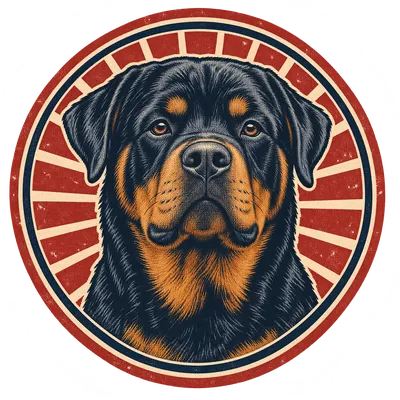 Retro badge
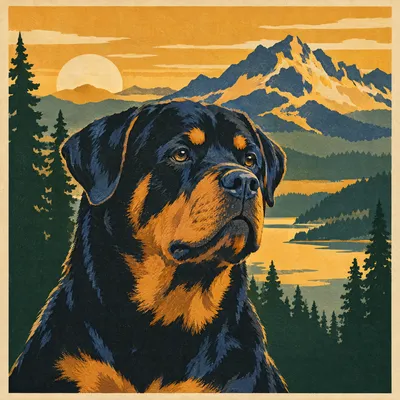 National park poster
 Woodblock print
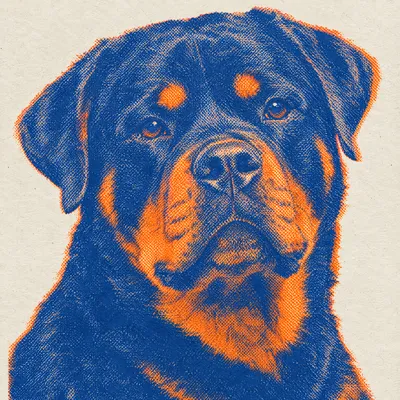 Risograph print
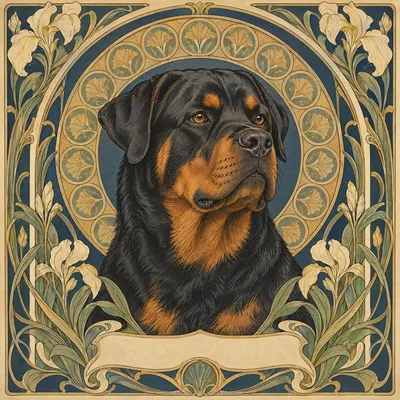 Art nouveau
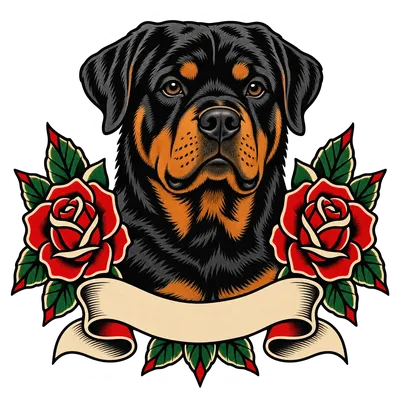 Tattoo flash
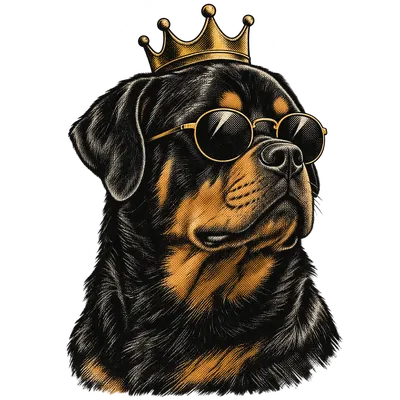 Crown and shades
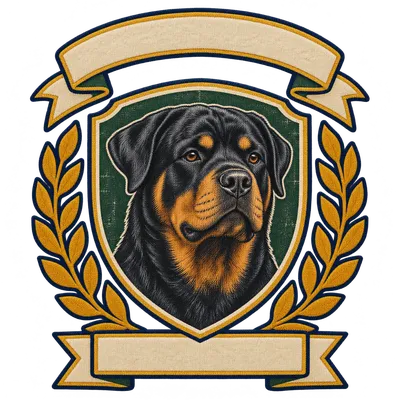 Varsity crest
A Rottweiler's life stages
A Rottweiler is a large to giant dog by its recorded weight; the stages below follow the giant band, and the age the senior years may start depends on size.
- PuppyBirth to 6 months
- Puppy or young adult6 to 9 months
- Young adult9 months to 3 years
- Young or mature adult3 to 4 years
- Mature adult4 to 7 years
- Mature adult or seniorFrom 7 years
Stages from the American Animal Hospital Association life stage guidelines. How the life-stage calculator works
A Rottweiler's age in human years
A Rottweiler's recorded weight spans large to giant dogs; this table uses the giant band, on the same method as our dog age calculator.
| Age | In human years |
|---|---|
| 1 year | 15 |
| 2 years | 24 |
| 3 years | 31 |
| 5 years | 45 |
| 7 years | 59 |
| 10 years | 80 |
| 13 years | 101 |
| 16 years | 122 |
Questions people ask about the Rottweiler
How big do Rottweilers get?
Most stand about 22 to 27 inches at the shoulder and weigh about 93 to 110 lb, with males at the taller, heavier end and many big males above that.
Do Rottweilers shed?
Yes. The short double coat sheds a moderate amount all year and blows out more heavily in spring and fall. Weekly brushing, and more during a shed, keeps most of it off the floor.
What is the Rottweiler rumble?
A low, steady grumble many Rotties make when they are relaxed and happy, often during petting or a long lean. Owners compare it to a cat's purr. It can sound alarming to new owners, and it means the opposite.
Do Rottweilers drool?
A little. Most drool after drinking, at mealtimes or when something smells good, though far less than the heavy-lipped mastiff breeds.
Is a Rottweiler a lot of dog for a first-time owner?
It is a lot of dog for anyone. Rottweilers are large, strong and slow to mature, so first-time owners do well to meet several adults, talk with longtime owners and think hard about size, strength and daily time.
Related breeds
The same size, or from the same country.




For your Rottweiler
Every dog is an individual. What we describe here is what is typical, from owners' experience and published breed descriptions, not a promise about any one dog. Meet the dog in front of you before you decide.
Breed facts: Wikidata, read 2026-10-03, which anyone may reuse, and the breed's Wikipedia article, read 2026-10-08. The ratings in "Living with" are ours, from those facts.
Unlock unlimited calm listening, free
Quiet music for the hours your dog is home alone, and the occasional note about new designs.
Unlimited listening is unlocked on this device. The Soundtrack player is ready when you are. Open the Soundtrack player